
About Ibi
I’m Ibi Malik — a percussionist who couldn’t find a handpan lesson that fit, so I built the school I wanted. This is the story, and why it’s all free.
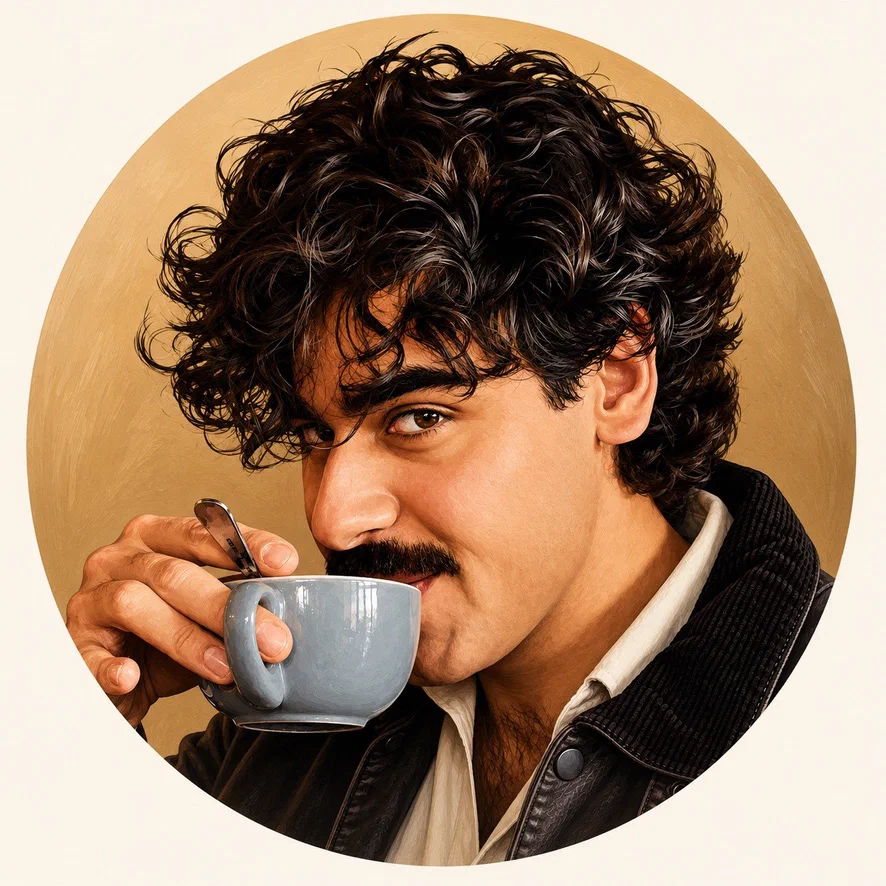
Hi, I’m Ibi #
I bought a secondhand 9 note D Kurd off Facebook Marketplace, could not find a lesson that fit, and built the school I wanted.
The longer version #
I have spent my working life around percussion. I ran Gawharet El Fan and Malik Instruments, built the Darbuka Mastery Programme, and taught a darbuka school. I have sold instruments, made instruments, shipped instruments, argued with customs about instruments, and taught several hundred people to play one.
So when the handpan arrived, I was not a beginner. I knew how to practise. I knew what a hand should feel like on a drum head. I knew, crucially, that when something is not working it is usually the technique and not the person.
And I still could not find a lesson that fit.
The videos assumed a different instrument — a different scale, a different note count, a layout that did not match what was in front of me. Or they jumped three steps ahead, from “here is how to hold your hand” to a finished piece with no bridge between. Or, most maddeningly, they taught in abstractions: “play the third note of your scale”, “move to the fifth”. Which is a perfectly sensible sentence to a pianist and a completely meaningless one to somebody looking down at eight identical-looking dimples in a piece of steel, in a room, alone, on a Tuesday.
I got past it because I already had the tools. A true beginner hits that same wall much harder. And what happens then is not that they conclude the teaching was bad. They conclude that they are not musical, that the instrument is beyond them, that they made an expensive mistake. A £1,500 instrument becomes furniture in the corner of a room, and someone who would have loved playing spends the rest of their life saying “I tried, it wasn’t for me.”
That happens a lot. It is the thing this site exists to stop.
Why free, and why all of it #
I went looking for a school to point people at, and every one I found was the same shape: free content as the taster, paid course as the destination.
That model is not evil. People deserve to be paid. But it has a structural problem that nobody talks about: the free material has to be incomplete on purpose. If the free path actually worked, nobody would buy the course. So the free path is always missing the connecting piece, always stops just before the part that would have made it click.
And it gets worse at the buying stage. Handpan buying advice, where it exists at all, mostly comes from people who sell handpans. Sometimes that is disclosed. Often it is affiliate links and a “which handpan should I buy” quiz that somehow always lands on the same maker.
So there is a gap exactly where a beginner is most vulnerable, most confused, and about to spend more money than they have ever spent on a musical instrument.
I do not need this to be a business. I have had businesses. What I want is for there to be more handpan players in the world, and for the ones who start to not give up in month two.
So: the entire course is free, start to finish, nothing held back. No paywall, no locked lessons, no premium tier arriving later.
Why D Kurd, and only D Kurd #
Because the single biggest failure of handpan teaching online is the mental translation it demands.
Teach on one instrument, and I can say “the B♭, bottom right” and you can just do it. What is on the page is what is in your lap. No counting round the circle, no theory homework before you can make a sound.
D Kurd is the most common handpan scale in the world, so this is not a narrow choice — it is the choice that covers the most people. It is also complete, chord-rich, forgiving, and easy to resell if you change your mind. The full argument is here.
If I ever teach a second scale, it will be a second complete course, not a scattering of alternate lessons.
What this site does — and doesn’t #
- Nothing to sign up for, nothing to buy. No accounts, no adverts, no analytics, no content behind an email address.
- No affiliate links and no maker sponsorship, ever. I don’t sell handpans and I never take commission on one.
- No popups, countdown timers or fake scarcity, and no “premium” tier.
- I will never recommend an instrument I would not tell a friend to buy.
- Nothing here is for sale. Not the lessons, not the guides, not my time.
If any of that ever changes, I will say so here, plainly.
Get in touch #
A question about a lesson, a story about your first groove, or spotted a mistake? I’d love to hear from you: ibraheem@malik5.com. I read all of it.
Thank you for reading this far. Go and play something.